
 Chirply
SMS deliverability is about whether messages reach their intended destination, as reported through the available delivery information. Improving it starts with permission, a correctly configured sender, accurate recipient data and an investigation of actual failures. Changing a few words or slowly increasing sends cannot fix every delivery problem.
For an agency managing several clients, review each client's sender, audience and message purpose separately. This guide covers prevention and measurement. If a particular text has already failed, start with the SMS sending-failures troubleshooting guide.
Start with the message status, not an assumed cause
A message accepted for processing has not necessarily reached a phone. Keep the provider's status and error code so your team can distinguish a queue, a sending failure and a delivery failure. Twilio's message-status documentation explains the available states.
| Status | What to investigate |
|---|---|
| Queued | Whether the message is still waiting to be sent and whether the delay fits the use case. |
| Sent | The provider has sent the message onward; a final delivery receipt may still be unavailable. |
| Delivered | A delivery receipt was received. This does not establish that the recipient read or acted on the SMS. |
| Failed | Inspect the error explaining why the provider could not send it. |
| Undelivered | Inspect the delivery error and identify whether it concerns the recipient, sender, route or filtering. |
Keep messages awaiting a final outcome visible in reports. A campaign viewed immediately after sending and the same campaign viewed later can show different delivery results. Pick a consistent reporting interval before comparing clients or campaigns.
Verify the sender for the actual destination
For Twilio business messaging to US numbers from a +1 local 10-digit number, check the approved A2P 10DLC campaign and the sender's association with its Messaging Service. A purchased number and a submitted registration are not the same as a sender attached to an approved campaign. See Twilio's A2P 10DLC overview and Chirply's agency registration guide.
Toll-free numbers and other sender types have their own requirements. Review the provider's rules for the country, number type and use case you actually use. Do not present US local-number registration as a worldwide requirement for every SMS sender.
Record the client workspace, provider account, sending number, message purpose and person responsible for registration. Recheck those details when moving a number or changing a client's provider connection. Using the wrong workspace can produce an apparently valid setup for the wrong business.
Keep permission and recipient records usable
Twilio's messaging policy requires consent for the messages being sent, clear sender identification and a way to withdraw consent. Keep a record of how and when the recipient agreed and what they agreed to receive. Review the current provider policy for the particular program and destination.
Do not treat a purchased list, an imported phone field or a previous unrelated inquiry as proof of permission for a new campaign. An opt-out should remain effective across the sending process. Preserve the suppression information your team needs rather than deleting a record and later importing the same number as a new prospect.
Validate formatting and the intended recipient before launch. A correctly formatted phone number does not prove that it can receive SMS, belongs to the intended person or has consented. Resolve a bad country code or a known invalid destination before attempting another send.
Write messages that match the expected conversation
Identify the business and give one relevant next action. Use a recognizable destination when including a link, and inspect the complete URL and landing page. The message, link and landing page should describe the same business and offer. Avoid a generic message that becomes misleading when personal information is missing.
Do not rely on a universal list of forbidden marketing words. Filtering can involve policy, sender and carrier factors as well as content. Twilio's 30007 explanation identifies filtering by Twilio or a carrier; replacing capital letters alone does not establish that the underlying problem is fixed.
Review the final rendered text, including inserted names, dates and links. For a meeting-related message, use the appointment reminder examples and keep confirmation, delivery and attendance as separate outcomes.
Test the workflow before increasing volume
Use a small set of your own consented test recipients to check the actual path. Verify the selected sender, recipient, message text, timing and reply destination. If a workflow sends a text after a form submission, test the form and the workflow together rather than testing only a manual message.
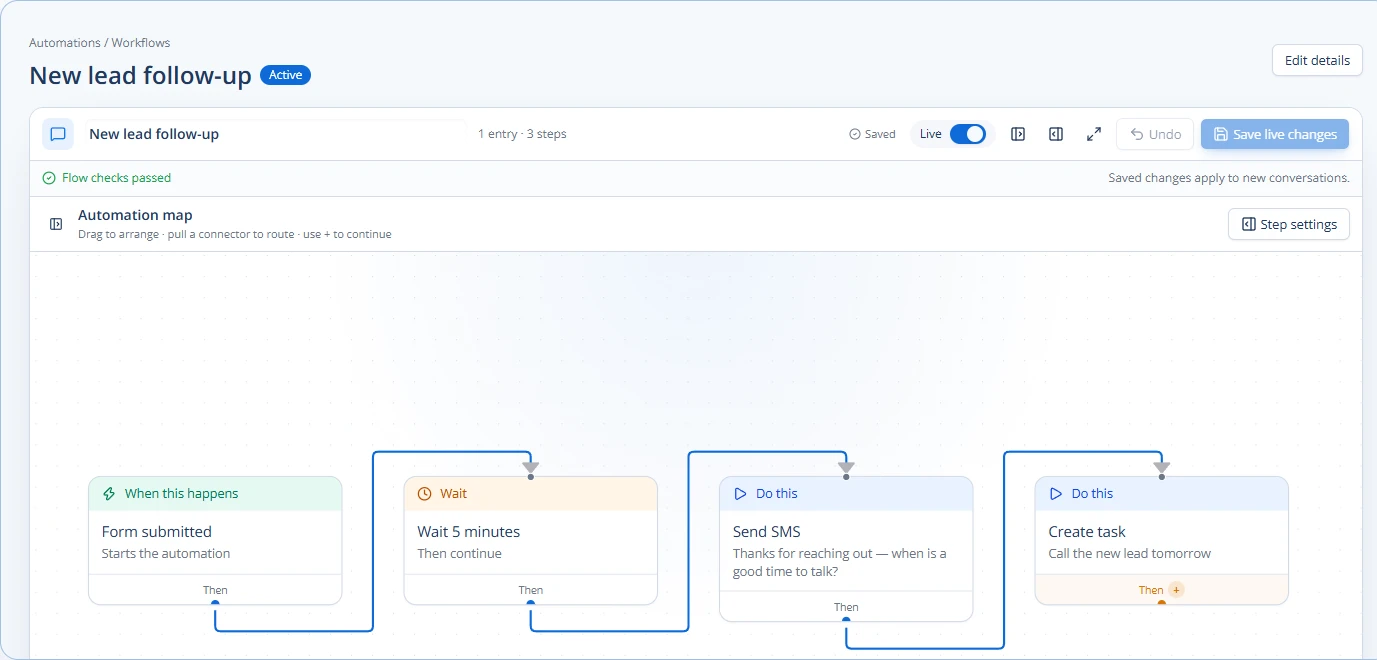
Check what happens when a contact is missing a phone number, has opted out, or submits the form twice. Assign someone to read replies. A working outbound send is only one part of a two-way customer conversation.
Use the sender's actual throughput and queue behavior when planning volume. Gradually testing a rollout can reveal configuration problems, but there is no universal warm-up schedule that guarantees delivery or replaces registration. If a test exposes a permission or sender problem, correct it before sending to a larger audience.
Use a repeatable agency preflight checklist
| Review | Evidence to keep |
|---|---|
| Correct client | Workspace, provider account and sender match the business. |
| Sender readiness | The required registration or verification is complete for that sender and route. |
| Audience permission | Consent context and current opt-out exclusions are available. |
| Recipient data | Country codes and known invalid destinations have been reviewed. |
| Message content | Final text, links and landing page match the expected message purpose. |
| Automation | Trigger, wait, duplicate handling and reply ownership have been tested. |
| Delivery review | One person owns failure investigation and provider escalation. |
In Chirply, use Communications to inspect message activity and statuses in the relevant workspace. The status detail can show the stored provider error when one is available. For the connection itself, use the Twilio setup guide.
Measure delivery without overstating the result
Define your metric and reporting time. For example, if a fictional campaign has 100 submitted messages, 80 delivered, five failed, three undelivered and 12 still awaiting a final outcome, the observed delivered share is 80% at that moment. Keep the 12 unresolved outcomes alongside the percentage. This is an illustration, not a benchmark or Chirply customer result.
Break failures down by code, sender, destination and campaign where the data supports it. Keep replies, opt-outs, bookings and sales separate from delivery. A delivered SMS is not evidence of a conversion, and a better delivery rate does not by itself prove that a campaign generated more revenue.
Start with the largest repeated failure category, fix the specific cause, then compare a later equivalent sample. Explore Chirply's communication and automation features and current pricing to match the platform to the workflow your agency needs.
Common questions
Answers at a glance
What is SMS deliverability?
SMS deliverability concerns whether messages reach their intended destination, based on the delivery information available. It is different from an API accepting a message, a recipient reading it or a campaign producing a sale.
Does A2P 10DLC registration guarantee SMS delivery?
No. For applicable US-bound local-number traffic, registration and the correct sender association are necessary setup checks. Consent, recipient data, message purpose, routing and filtering still affect individual outcomes.
Is there a universal SMS number warm-up schedule?
No universal schedule guarantees delivery. Use controlled testing and the provider’s actual throughput guidance. Increasing volume gradually does not replace required registration, consent or correction of a known sending problem.
How should an agency calculate an SMS delivery rate?
State the denominator and reporting time, and keep unresolved outcomes visible. For example, 80 delivered messages out of 100 submitted is an observed 80% delivered share at that time, even if some messages are still pending.
Put the system to work
Run the whole client journey in one place.
CRM, phone, messaging, automation, funnels, and AI, connected on one contact record and ready for your brand.
See Chirply plans