
 Chirply
Low call answer rates need a diagnosis before they need a new script. First separate failed attempts, unanswered ringing, voicemail and conversations with people. Then compare similar audiences using the same definitions. Otherwise, an apparent improvement may just mean more calls reached voicemail.
This checklist is for agencies reviewing legitimate outbound follow-up. It explains what to record, how to investigate a number that is being labeled as spam, and how to connect call outcomes to the next action in Chirply.
Define the result before changing the campaign
Keep these measures separate in your working report:
| Measure | Calculation | What it tells you |
|---|---|---|
| Connection rate | Answered connections / outbound attempts | Whether calls connected, including machines |
| Human answer rate | Confirmed human answers / outbound attempts | How often a person actually answered |
| Qualified conversation rate | Qualified conversations / outbound attempts | Whether calls reached the right people |
| Booking rate | Appointments attributed to those attempts / outbound attempts | Whether conversations led to the intended next step |
Write down which attempts you include. Keep test calls, retries, canceled attempts and internal calls identifiable so a change in the denominator cannot quietly change the conclusion.
Twilio documents that a completed call can have been answered by a person, an IVR or voicemail. It is not proof of a human conversation. See the Twilio Call resource. Use a reviewed call outcome to distinguish them; do not relabel every completed call as a qualified lead.
For example, if 100 illustrative attempts produce 30 connections and 12 confirmed human answers, the connection rate is 30% and the human answer rate is 12%. These are sample calculations, not Chirply customer results or performance targets.
Find the failure pattern
Review a bounded period and record the originating number, lead source, recipient's timezone, local call time, provider status and human outcome. Compare like with like: a requested callback and a months-old lead list are different audiences.
| Pattern | First investigation | Evidence to retain |
|---|---|---|
| Failed attempts | Provider errors, number format and account configuration | Call identifiers, timestamps and error codes |
| Ringing without answers | Audience expectations, local timing and repeat attempts | Attempts per contact and time-window counts |
| Connections but few conversations | Voicemail or IVR being counted as people | Reviewed outcomes and unknown classifications |
| Reported spam label | Number identity and provider reputation review | Affected number, carrier and observed label |
| Conversations without bookings | Offer fit and the next-step handoff | Outcome notes and agreed follow-up |
Do not change the audience, phone number, script and schedule together. You will lose the ability to tell which change mattered. Record the starting conditions, choose one change, and compare a similar set of eligible contacts over a stated period.
Investigate spam labels through the provider
Ask what label was actually displayed and on which receiving network. A missed call alone does not establish that a carrier labeled it as spam. Check that your business identity, callback routing and number configuration are accurate.
For US Twilio numbers, Voice Integrity submits registered numbers to carrier analytics vendors for review. Those vendors may change the labeling; registration is not a guaranteed removal or a promise that people will answer.
Keep the number and examples available when opening a provider investigation. Address the calling behavior behind complaints as well as the displayed identity. Replacing numbers simply to escape an unresolved reputation problem does not diagnose the cause.
Test timing against your own audience
There is no universal best hour established by this guide. Start with the recipient's timezone, their stated callback preference and the calling rules applicable to your campaign. Do not copy a generic morning or evening recommendation into every market.
Select two appropriate time windows and keep lead age, source and attempt policy comparable. Log the number of attempts and confirmed human conversations in each. A small difference in a handful of calls is a reason to keep observing, not a basis for promising a lift in sales.
Remove wrong numbers and honor requests to stop further contact. If a person asks for a specific callback time, record it as the next action rather than repeatedly trying the same number without context.
Keep the investigation connected to Chirply
In Chirply's Calls view, review the recorded status and assign a call outcome where needed. Use the contact record for context, then create the appropriate follow-up task. Keep provider error details in your investigation notes so a teammate can reproduce the issue without guessing from a percentage.
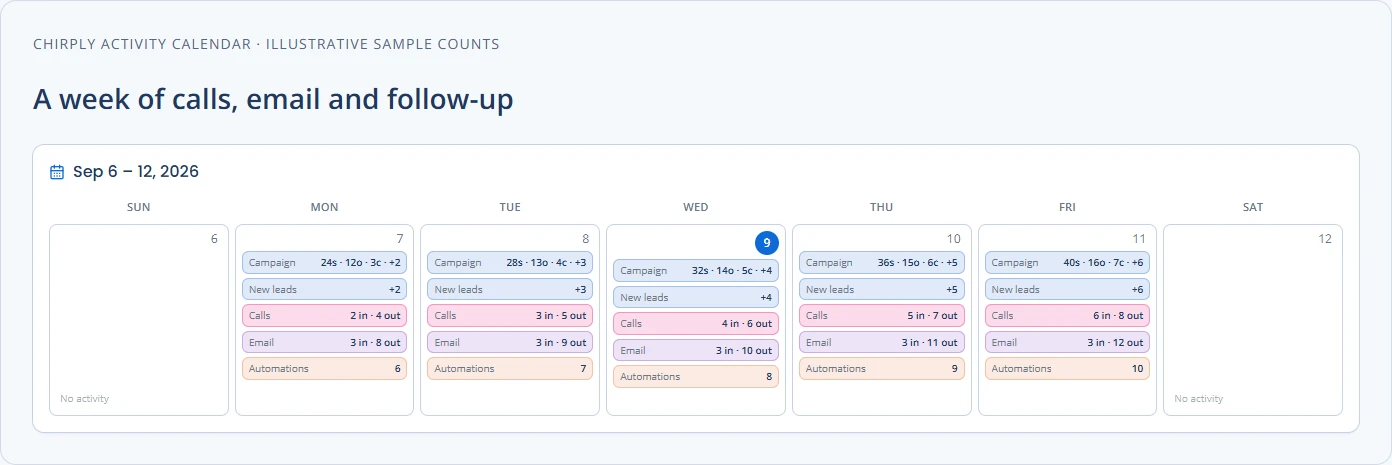
The activity calendar provides a daily view of channel activity. The screenshot uses synthetic counts. It is useful for seeing when work happened; it does not by itself calculate human answer rate or prove that a call caused a sale. Keep the campaign worksheet alongside those operational counts.
If telephony is not connected yet, start with the Twilio setup guide. For the wider calling workflow, review Chirply's phone system. Check current plans before a pilot; connected-provider usage is billed separately.
Close the loop with a short decision log
At the end of the review, save the period, audience, attempt definition, observed problem, single change and results. Include unknown outcomes instead of forcing them into the human or voicemail bucket. Choose the next action from that evidence: repair configuration, investigate labeling, adjust a suitable time window, improve contact data or fix the booking handoff.
This produces a repeatable diagnosis for the next campaign and gives the team something more useful than an unexplained answer-rate percentage.
Common questions
Answers at a glance
Does a completed Twilio call mean a person answered?
No. Twilio documents that a completed call may have connected to a person, voicemail or an IVR. Use reviewed outcomes to distinguish human conversations.
What is a good call answer rate?
This guide does not prescribe a universal benchmark. Compare similar audiences using the same attempt definition, and separate connections, human answers, qualified conversations and bookings.
Does registering a number guarantee removal of a spam label?
No. Twilio Voice Integrity submits US numbers to carrier analytics vendors for review. Labeling decisions and the underlying calling behavior still matter.
Can the activity calendar prove a call caused a sale?
No. The calendar shows operational activity by day. Revenue attribution and human answer rate require their own definitions and supporting records.
Put the system to work
Run the whole client journey in one place.
CRM, phone, messaging, automation, funnels, and AI, connected on one contact record and ready for your brand.
See Chirply plans