
 Chirply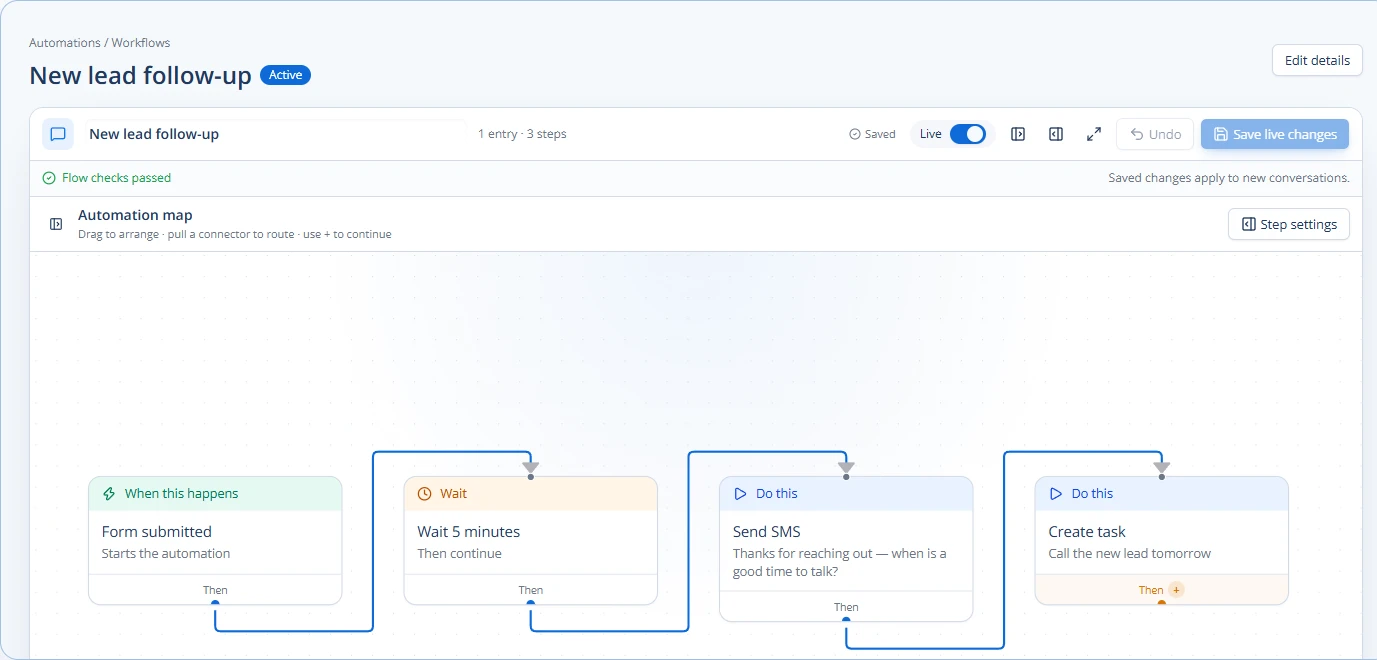
Agencies often miss out on new business when calls go unanswered. To fix this, you need a clear plan for following up. This guide will show you how to set up a system that combines automatic and manual steps. This way, no potential client is forgotten.
Separate the missed-call reply from the longer follow-up in Chirply
The first acknowledgment and the later follow-up serve different purposes. Configure them together so two separate rules do not send the same message to the caller.
- Open Phone → Numbers and select the number that receives the calls. Review its missed-call text-back settings and the message body. The feature is configured per number and requires SMS support; a voice-only number cannot send the acknowledgment.
- Review the available hours and unknown-caller settings against the business's response policy. Write a short message that identifies the business and tells the caller what happens next. Do not imply a person has reviewed the inquiry when the text is automatic.
- Create the later steps in Automations → Workflows. Use the appropriate call trigger and filters, then add a task or a carefully timed message. Confirm which call outcomes qualify instead of treating every completed call as a missed call.
- Test from a phone you control. Let one test call go unanswered, then check the contact timeline and sending result. Test a call that is answered too, so you can verify the rule does not send the missed-call response in that case.
- Review replies in Conversations and define who takes over. Before adding more touches, check whether a human response or a booking should end the follow-up path.
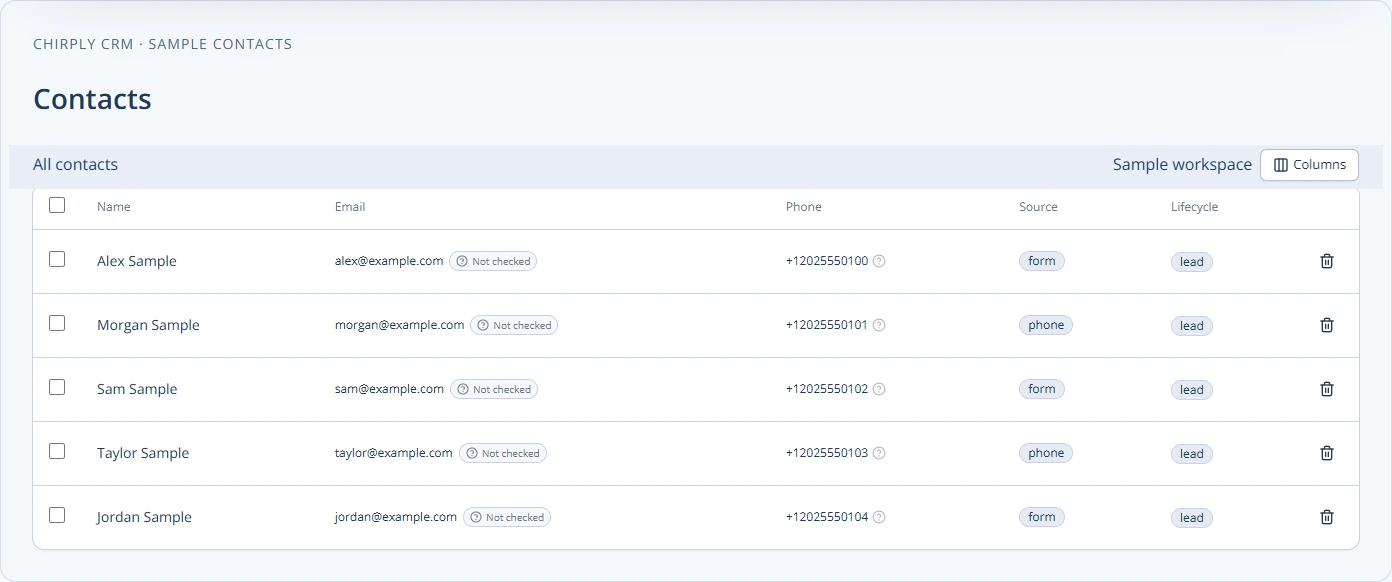
The sample automation above shows the builder's wait, message and task controls; it is not a screenshot of a configured missed-call trigger. The contacts image below shows where the resulting lead can be found.
Compare missed calls, successful acknowledgments, replies and resulting bookings over the same period. Those are different outcomes. Review Chirply's speed-to-lead tools and shared inbox, then start with one number and one owner for the follow-up.
Why a Missed Call Follow-Up Plan Matters
Think about it: every missed call is a chance lost. It could be a new client, a returning client with a question, or a referral. If you don't follow up quickly and consistently, that person will likely call someone else. A good follow-up plan helps you:
- Catch lost leads: Turn missed calls into real conversations.
- Show you care: Clients appreciate quick responses.
- Build trust: A reliable follow-up makes your agency look professional.
- Save time: A clear plan means less guessing about what to do next.
Without a system, your team might follow up sometimes, but not always. Or they might follow up differently every time. This leads to confusion and missed opportunities.
Building Your Follow-Up Cadence: The Steps
A "cadence" is just a fancy word for a sequence of steps. Here's how to build one for missed calls. It involves both automated actions (things that happen by themselves) and manual actions (things your team does).
Step 1: Immediate Automated Response (Within 5 Minutes)
When a call is missed, the first step should be fast and automatic. This shows the caller you know they tried to reach you.
- Automated SMS: Send a text message right away.
- Example: "Hi [Caller Name], we just missed your call from [Your Agency Name]. We're sorry we couldn't connect! How can we help you today?"
- Why it works: Most people read texts quickly. It's less intrusive than another call.
- Compliance note: For text messaging, make sure you understand provider registration requirements such as A2P 10DLC for business texting. Rules can change, so always check with your provider or legal counsel. You can find more information on Twilio's A2P 10DLC overview: https://www.twilio.com/docs/messaging/compliance/a2p-10dlc.
- Automated Email: If you have their email from a previous interaction or form fill, send a quick email.
- Example: "Subject: We missed your call! Hi [Caller Name], We received a call from you moments ago. We'd love to help. Please reply to this email or call us back at [Your Phone Number] when you have a moment."
- Why it works: Provides another way for them to connect and can include more details.
- Compliance note: For email, be aware of rules like the CAN-SPAM Act. Always verify current requirements with your counsel or the FTC's CAN-SPAM Act compliance guide for businesses: https://www.ftc.gov/business-guidance/resources/can-spam-act-compliance-guide-business.
Step 2: First Manual Attempt (Within 1 Hour)
If there's no response to the automated messages, a person from your team should try to reach out.
- Manual Phone Call: Have a team member call the number back.
- What to say: "Hi, this is [Your Name] from [Your Agency Name]. We received a call from this number earlier and wanted to follow up to see how we can help."
- Why it works: A personal call is often the most effective way to connect.
- Tips for calling: Be friendly, brief, and ready to listen. If they don't answer, leave a short voicemail.
- Log the attempt: Record that you tried to call in your CRM. This helps track your efforts.
Step 3: Second Manual Attempt (Next Business Day)
If the first manual attempt doesn't connect, try again the next business day.
- Manual Phone Call (again): Call them back at a different time of day.
- Why it works: People have different schedules. A different call time might catch them.
- Manual SMS/Email: Send another quick message if you haven't heard back.
- Example SMS: "Just checking in again from [Your Agency Name] regarding your call yesterday. Still happy to help when you're free!"
- Example Email: "Subject: Following up on your call – [Your Agency Name] Hi [Caller Name], We tried reaching you yesterday after your call. Please let us know the best time to connect."
- Log the attempt: Update your CRM with this second attempt.
Step 4: Final Manual Attempt (Within 3-5 Business Days)
If you still haven't connected, make one last effort.
- Manual Phone Call: One more call.
- Detailed Email: Send a more detailed email offering specific help or resources.
- Example: "Subject: Can we still help with [Their Expected Need]? Hi [Caller Name], We've tried to reach you a few times since your call to [Your Agency Name]. We specialize in [mention a key service, e.g., 'digital marketing for small businesses'] and wanted to see if we could help with [a common problem your clients face]. If now isn't a good time, please feel free to reach out when it is. You can also visit our website at [Your Website]."
- Why it works: This email offers value and shows persistence without being pushy.
- Log the attempt: Mark the lead as "Attempted Contact Complete" or similar in your CRM. You can then put them into a longer-term nurturing sequence if appropriate.
Tools to Make It Easy
Managing all these steps can seem like a lot of work. This is where modern tools come in handy.
- CRM (Customer Relationship Management) System: A good CRM is the heart of your follow-up plan. It tracks calls, messages, and emails. It can also automate many of the steps. For agencies, a white-labelable CRM like Chirply can connect contact records, calls, SMS, and email, making it easy to see all interactions in one place. It can also set up automations to send those first immediate messages.
- Automation Software: Many CRMs have built-in automation. This allows you to set up rules like "If call missed, then send SMS" or "If no reply to SMS, then create a task for agent to call."
- Integrated Communication Platforms: Tools that combine calling, texting, and email in one place streamline your team's work. This helps ensure that your team can easily manage all aspects of client communication, from initial outreach to ongoing support. For more on effective SMS use, check out our article on how to use sms for client onboarding and support.
Example Follow-Up Cadence Table
Here's a simple table to illustrate the cadence:
| Time After Missed Call | Action Type | Method | Details | Who Does It? |
|---|---|---|---|---|
| Immediate (0-5 min) | Automated | SMS | "Missed your call. How can we help?" | System |
| Immediate (0-5 min) | Automated | "We missed your call! Reply here." | System | |
| Within 1 Hour | Manual | Call | Personal call, leave voicemail | Sales/Support Agent |
| Next Business Day | Manual | Call | Call again, different time | Sales/Support Agent |
| Next Business Day | Manual | SMS | "Checking in again." | Sales/Support Agent |
| Next Business Day | Manual | "Following up on your call." | Sales/Support Agent | |
| Day 3-5 Business Days | Manual | Call | Final personal call | Sales/Support Agent |
| Day 3-5 Business Days | Manual | Detailed email, offer specific help | Sales/Support Agent | |
| After Day 5 | Automated | Add to long-term nurturing campaign | System |
Review and Improve Your Cadence
Once you set up your missed call follow-up cadence, it's not a "set it and forget it" task. You need to look at how it's working regularly.
- Track your success: How many missed calls are you turning into conversations?
- Ask for feedback: What do your team members think of the process? Is it easy to follow?
- Adjust as needed: If certain steps aren't working, change them. Maybe your SMS message needs to be clearer, or your call times need to shift.
By consistently refining your approach, your agency can significantly improve its ability to connect with potential clients and grow. Using a robust platform that integrates communication and automation, such as Chirply, can help you manage and optimize these processes effectively.
Start by implementing the immediate automated responses and the first manual call. Then, build out the rest of your cadence step-by-step.
Common questions
Answers at a glance
What is a missed call follow-up cadence?
It's a step-by-step plan that combines automatic and manual actions to contact someone who called your agency and didn't get through. The goal is to make sure you connect with every potential client.
Why is an immediate automated SMS important?
Sending an automated SMS (text message) within minutes of a missed call shows the caller you know they tried to reach you. It's a quick, non-intrusive way to acknowledge their call and offer a way to reconnect, often leading to faster engagement.
How often should my team manually call back a missed call?
After an immediate automated response, your team should make a first manual call within one hour. If that doesn't connect, try again the next business day, and potentially a third time within 3-5 business days. Varying the call times can increase the chance of connecting.
What tools can help manage a follow-up cadence?
A CRM (Customer Relationship Management) system is key. It helps track all interactions and can automate initial messages. Look for systems that integrate calling, texting, and email to streamline your team's efforts.
Put the system to work
Try the workflow in your own workspace.
Review the feature, choose one sample contact and test the handoff before you expand it to the rest of your team.
Explore this Chirply feature See Chirply plans